.avif)





.svg)
.svg)


Sommaire



Publié le
4/3/26
-
5 min
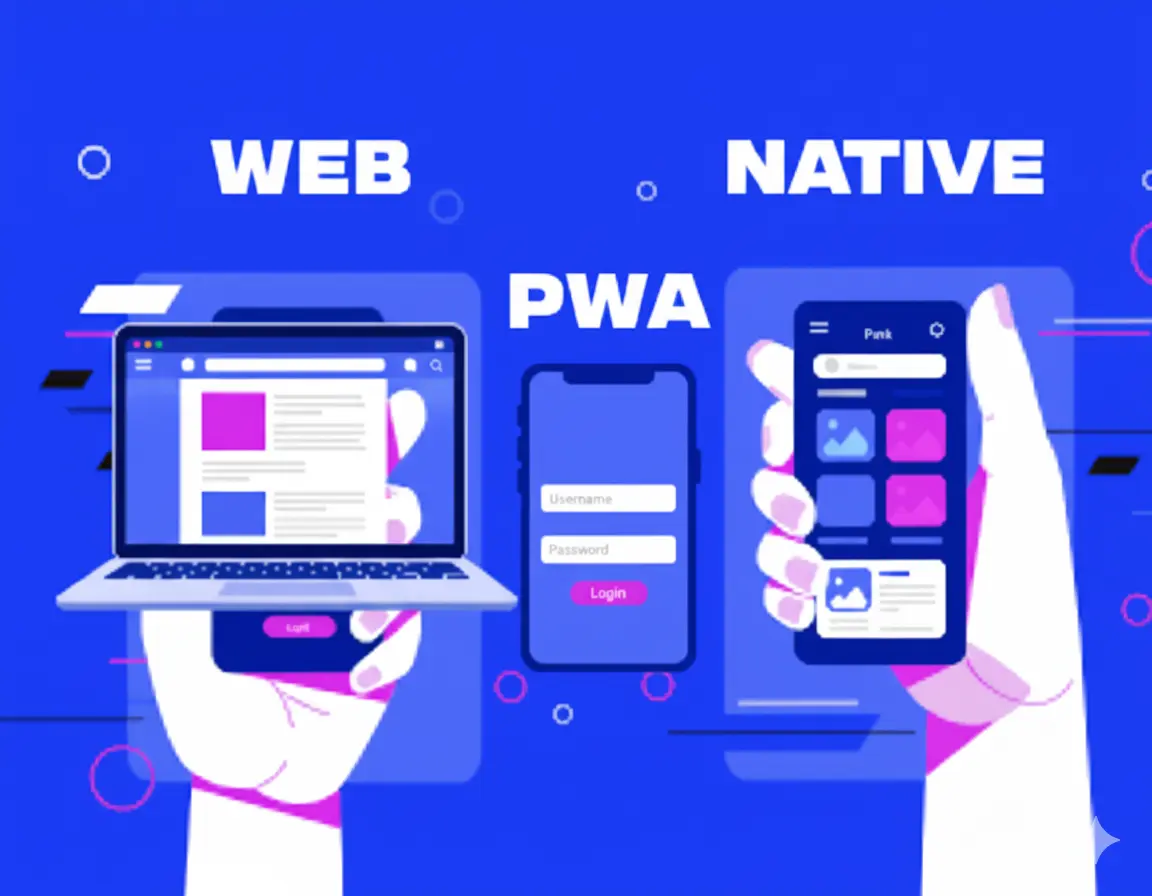
Choosing between a website, Progressive Web App, and native app is not a matter of gut feeling. The right decision combines a measurable goal, real-world usage, and controlled total cost. The parent article explains the impact of a mobile app on acquisition, conversion, and retention. Read What impact can a mobile app have on your business to anchor this choice in your results.
This guide provides clear guidance in five sections. First, a clear explanation of the three options. Next, a decision-making method focused on your goals. Then, a focus on experience and performance. This is followed by a section on data, security, and total cost. Finally, concrete scenarios to help you make a quick decision without sacrificing your long-term vision.
A website remains the widest gateway. A link is all it takes to reach everyone. You capitalize on natural referencing and landing pages. A fast and clear site can already convert at an excellent level. It excels when the priority is visibility, proof of value, lead generation, and initial sales. Its iteration rate is high. Its operating cost remains low if the technical base is simple and the media are well optimized.
The PWA combines the reach of the web with an app-like feel. It can be installed on the home screen, works in offline mode, and sends notifications to many devices. It shines when you need to deliver quickly, re-engage often, and maintain a unified code base. A well-designed PWA delivers very respectable fluidity thanks to caching and service workers. It is suitable for product catalogs, simple reservations, field forms, and lightweight premium content. Its quality depends on the rigor of your front-end stack and a precise caching plan.
Native apps aim for the ultimate experience. They take full advantage of sensors, graphics rendering, gestures, and local computing capabilities. They are distributed via app stores, which reinforces perceived trust and simplifies identification with Apple ID and Google. The initial and maintenance costs are higher, but the value increases when used daily and when the depth of functionality justifies a premium experience. For augmented reality, real-time video, and fine hardware access needs, native apps retain the advantage.
For more details on the difference between a PWA and a native app, you can watch this video.
The right technology depends on three factors: the desired result, the level of performance required by the user, and the maintenance budget over a one- to two-year horizon.
If your priority is mass acquisition with a short turnaround time, the website wins. Its reach is universal. Internal linking and landing pages capture demand. You test offers, measure responses, and make continuous adjustments. The site becomes the foundation of your marketing ecosystem and feeds other channels.
If your challenge is repeated engagement with a tight budget, the PWA has the advantage. Installation is lightweight. Loading times are short thanks to the cache. Web notifications re-engage without store barriers on a large part of the fleet. You distribute via a link. You focus on usage and maintain a single base to evolve.
If your product requires perfect fluidity, robust offline stability, and advanced hardware integrations, a native app is the way to go. High-frequency games and loyalty mechanics. Sensitive transactional journeys. Fine geolocation and continuous Bluetooth. Native SDKs provide precise control over security, session management, and local storage.
Three questions are all you need to decide.
The best option is the one that achieves the defined threshold with the least effort while remaining scalable. You can start with a website, switch to a PWA for repeated use, and then move to native as soon as the proof of value is solid.
Perceived speed determines adoption. A native app preloads views, animates smoothly, and handles complex interactions with great stability. A modern PWA can offer excellent fluidity thanks to intelligent caching and fine-grained resource management. An optimized site remains responsive when the front-end architecture is simple and media weight is controlled.
Onboarding often determines success. Reduce friction with instant registration, reliable SSO, and stable session recovery. Permissions must come at the right time with a clear promise. Notifications must be based on real context. Forgotten shopping cart. Relevant recommendation. Appointment reminder. Abuse destroys trust. Accuracy reinforces it.
Access to hardware drives strategy.
• Geolocation and continuous tracking. Feasible everywhere. More robust and economical natively.
• Bluetooth and NFC. Superior control natively. Viable in PWA in simple cases.
• Augmented reality and demanding 3D. Viable at the highest level natively. Simple demonstration possible in PWA.
• Sensitive offline mode. Native advantage for managing long scenarios and synchronization conflicts.
• Notifications. PWA effective on many devices. Maximum reliability and granularity natively.
5G expands the scope. Streaming without waiting, near-instant synchronization, credible augmented reality product trials. The web and PWA benefit from adaptive media. Native goes further with low-latency live sessions and more stable immersive experiences. If your proposal is based on real-time demonstration, 5G is a game changer and justifies a more ambitious investment.
For a conversion-oriented website, implementation often costs between €8,000 and €25,000. Tools and hosting cost around €50 to €300 per month. Annual maintenance represents 10 to 15 percent of the initial cost. This is the fastest way to capture demand and test offers.
A basic to mid-level PWA starts at between €25,000 and €70,000. Monthly services cost between €100 and €400. Maintenance costs around 12 to 18 percent per year. This is a good compromise when usage is regular and you want a single code base.
A native iOS and Android app requires the most investment. Expect to pay between €60,000 and €200,000 at launch, depending on the depth of functionality and hardware access. Monthly infrastructure costs range from €200 to €800. Maintenance costs rise to 15-25% per year, with store reviews to be included in the schedule.
The factors that drive up the cost remain constant: real-time and robust offline capabilities, advanced sensors, business integrations, and visual finish. To keep the budget under control, frame an MVP centered on three promises, measure conversion and retention at seven and thirty days, automate testing, and cut out rarely used features. The right rule can be summed up in one line. Choose the option that meets your performance threshold at the lowest cost of ownership, then keep a migration door open if usage takes off.
• Conversion-oriented website. Short timeframe. Low initial budget. Perfect foundation for SEO and qualified traffic.
• Top-tier PWA. Short to medium timeframe. Moderate cost. High value if usage is repeated.
• Fully developed native app. Longer timeframe. Higher cost. Solid ROI if usage frequency is high and the experience must remain flawless.
Consider migration from the outset. The right choice is not set in stone. You can plan for a gradual ramp-up. Prove interest with a website and a PWA. Switch to native when engagement and retention signals justify it.
It all depends on your business and your goal
- Retail and e-commerce. Launch a fast website to capture demand and fuel your advertising. Add a PWA for lightweight installation, promotional notifications, and persistent shopping cart. Switch to native if you're aiming for advanced loyalty, subscriptions, augmented reality try-ons, and one-click payment.
- Services and reservations. The website serves local SEO and acquisition. The PWA manages scheduling, reminders, and simple changes. The native app becomes key with fine geolocation, calendar integration, and digital wallets. Notifications become a very powerful reactivation lever when they are contextual and moderate.
- Industry and B2B. The website centralizes documentation and generates leads. The PWA streamlines field forms and simple reports. The native app is essential when robust offline capabilities, sensors, and advanced security become critical for business continuity.
- Media products and communities. The website maximizes reach and SEO acquisition. The PWA creates a habit of consultation thanks to caching and reminders. The native app offers a more immersive reading and interaction experience with fine controls over audio and video quality.
Here's how you can decide without hesitation.
Don't choose a technology on principle. Choose the best impact, effort, and cost of ownership ratio. The website gains in reach and deployment speed. The PWA provides an installable experience at a reasonable budget and speeds up iteration. The native app maximizes performance, engagement, and access to hardware when value per user depends on perceived quality.
To help you make your decision, continue with the related articles
- Top 5 reasons to develop a mobile app in 2025
- What factors influence the price of a custom mobile app
- How much does it really cost to create a mobile app?