.avif)





.svg)
.svg)



Sommaire



Publié le
27/4/26
-
5 min

SoLocal has gone through several decades, from paper directories to digital transformation, including a significant receivership in 2020. This journey has left its mark on the perception of independent professionals: contracts that are difficult to cancel, promises not kept, budgets with no measurable return.
But the market has also changed. Google Business Profile, professional social networks, sector platforms and local digital agencies have intensified the competition. For a plumber, hairdresser or physiotherapist, every euro invested must generate a tangible result.
The sectors most concerned are those where local visibility is a direct issue: building craftsmen, restaurant owners, health professionals, driving schools. For these structures, a subscription that does not produce measurable results weighs heavily on an already tight cash flow.

They are polarized: satisfied people exist, but recurring grievances are specific and documented.
The opinions available on the main rating platforms draw a nuanced picture. On the one hand, customers who recognize an improvement in their local visibility. On the other hand, a significant volume of criticisms relating to specific and recurring points.
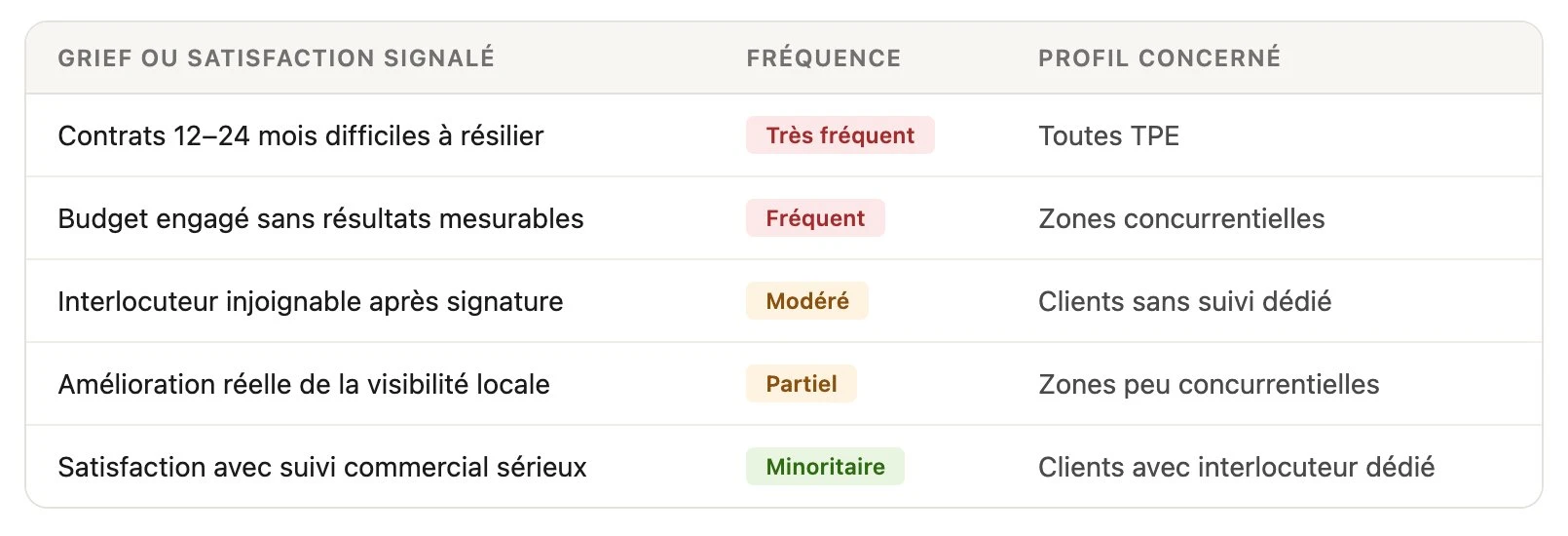
To remember: Positive reviews focus on two profiles: professionals in low-competitive areas, and those benefiting from active commercial follow-up. These conditions are not guaranteed when the contract is signed.
On directories and for a senior audience, yes. Faced with Google, less and less.
Yellow Pages maintains a reputation among seniors who are used to these directories to find a provider. Synchronizing business information across multiple platforms also improves the consistency of online data, an important criterion for local SEO.
On the other hand, SoLocal is struggling to convince people about natural referencing in the field. Pages created on directories rarely generate significant qualified traffic in competitive areas. Faced with Google Business Profile, which is free and directly integrated into search results, the argument for visibility on Yellow Pages is weakening year after year.
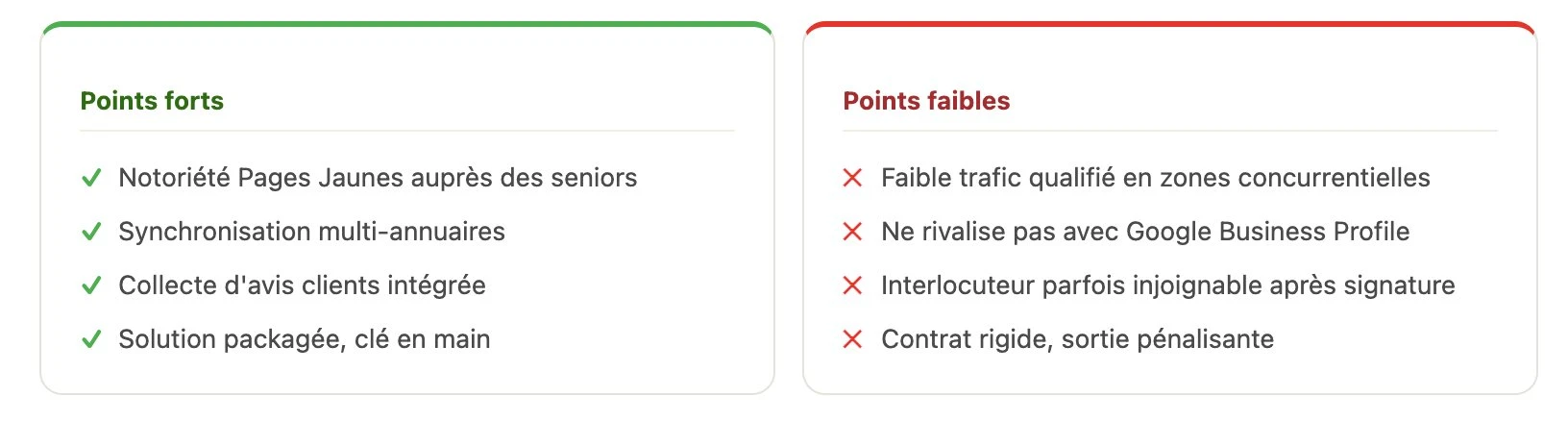
The real differentiator of SoLocal should be human support. Some customers benefit from it and are satisfied with it. But it is a commercial promise, not a contractual guarantee.
There are several, more flexible and often less expensive, starting with Google Business Profile.
The market for local visibility tools has grown considerably in recent years. Most alternatives have the advantage of being more flexible, more transparent in their operation, and often less expensive to use.
Google Business Profile is free, directly integrated into Google Maps, and generates a level of visibility that few paid subscriptions match in the same audience segment. This is the first instinct to have before exploring any other paid solution.
Yes, basically. Investing in SEO builds sustainable digital capital that belongs to you.
A directory offers you a presence among dozens of competitors in the same sector. A well-conducted local SEO strategy positions your site directly in the search results, without intermediaries between you and the potential customer.
Concretely, this involves pages structured around the real requests of your customers, explicit mentions of your geographical area, an up-to-date Google sheet, and consistent information across the entire digital ecosystem.
The amounts invested in an SEO strategy build digital capital that remains with your business. Those spent in a directory disappear with the termination of the contract, without leaving a lasting trace. Over 3 years, the profitability of the two approaches is not comparable.
Yes, with a radically different approach: transparency, site ownership, and measurable results.
Easyweb is aimed at small businesses who do not want to depend on an opaque contract or on a subscription logic that is disconnected from their real results. The approach starts from the concrete needs of the structure, its sector and its catchment area, to build a digital presence that belongs to it.
Concretely: creation or redesign of a structured website for local SEO, optimization of Google Business Profile, synchronization of information on relevant directories, and regular performance monitoring. Each action is documented, each result visible: positions on target queries, organic traffic, phone clicks.
For a manager with a small structure, the real question is not whether SoLocal is a bad platform in itself. It is to check whether the conditions in which he plans to engage really correspond to what this offer can bring him. And in most cases, this verification invites you to explore more controlled alternatives first, before signing anything.
Sustainable local visibility is being built, it cannot be praised. An optimized site, an active Google listing and a coherent local SEO strategy will always produce more results in the long term than a directory subscription whose results or output you have no control over.